Introducing the Career Assessment Insights Agent: Turning Assessments Into Actionable Career Guidance
Introducing the Career Assessment Insights Agent: Turning Assessments Into Actionable Career Guidance
Introducing the Career Assessment Insights Agent: Turning Assessments Into Actionable Career Guidance
Introducing the Career Assessment Insights Agent: Turning Assessments Into Actionable Career Guidance
Introducing the Career Assessment Insights Agent: Turning Assessments Into Actionable Career Guidance
Introducing the Career Assessment Insights Agent: Turning Assessments Into Actionable Career Guidance
Introducing the Career Assessment Insights Agent: Turning Assessments Into Actionable Career Guidance
Introducing the Career Assessment Insights Agent: Turning Assessments Into Actionable Career Guidance
Don't miss our breakout sessions!
Book time with our team on-site!
Our team is excited to meet you. Book a time that works best.

What is it?
The Career Recommendation Agent reviews a student's latest assessments and generates four career suggestions that match their results. Each career comes with reasoning for why it was suggested and next steps the student can work toward.
Career Recommendation Agent
Reviews a student's completed assessments and generates four matched career suggestions — with reasoning and next steps — automatically. No prompts, no manual context-building.
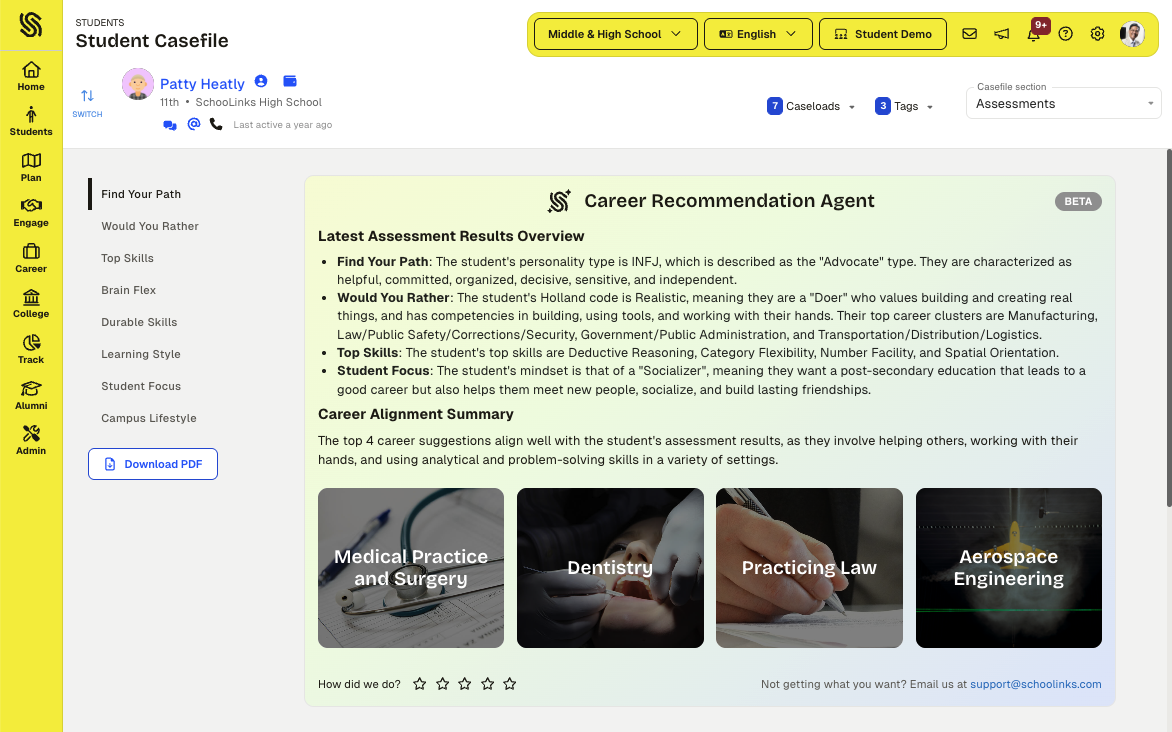
It works across four of our assessments: Find Your Path, Would You Rather, Student Focus, and Top Skills. A student needs to have completed at least two of these for results to generate. Once results are generated, they don't regenerate until the student completes one of the assessments again.
This is different from other agents in that the results are automatically calculated. There's no prompt, no chat, no manual context-building. The student takes the assessments, the system does the rest.
Right now this is available to staff. We want to release it to students once the overall sentiment is good.
Why and how?
The assessment experience matters
This builds on one of the things we've thought from the beginning: driving impact from chatbots is a challenge because you're building up context manually, and it's kind of hard. As opposed to a swipeable quiz, the swipeable assessment, the kind of dating app interface, that stuff is more engaging and natural for students.
What we're doing is piping the information from those assessments into this agent. That's what makes it faster and better. As opposed to something like Google Career Dreamer, where people might not be able to articulate what they want, we've created the framework to get students, in a fun, easy way, to answer these questions and build up the information that the deterministic models need to know what to do.
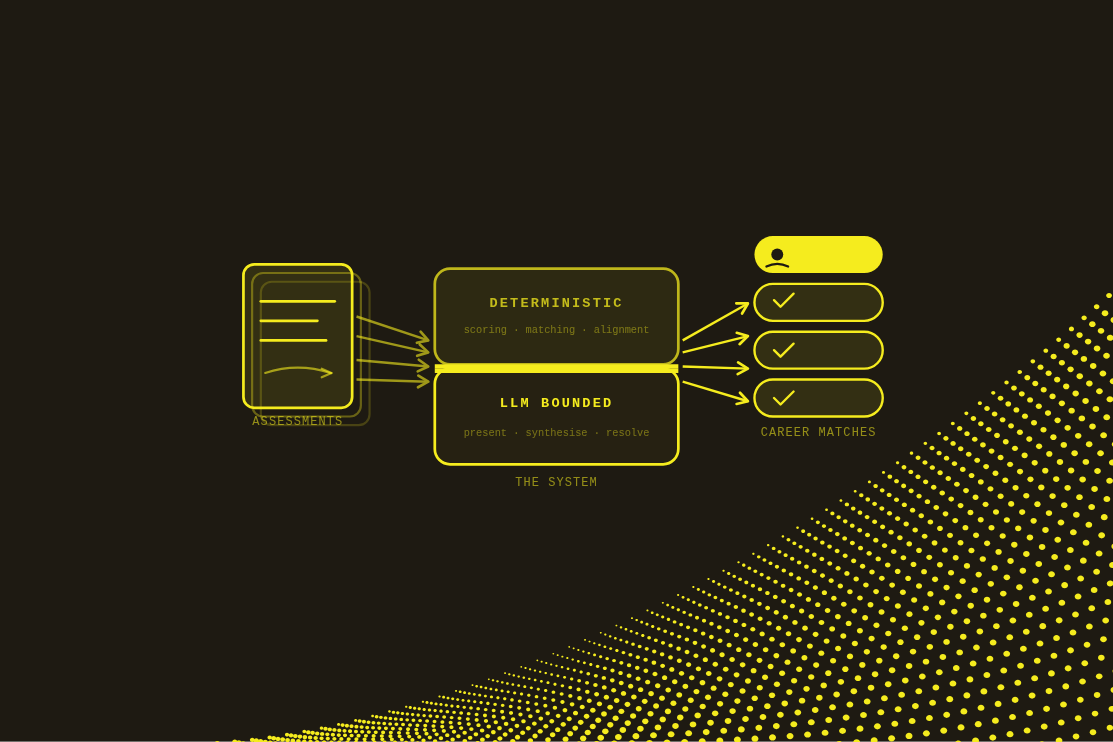
Then the LLM combines the inputs of all those deterministic models and interprets their alignment or lack of alignment.
Short, repeatable assessments vs. the hour-long approach
Other providors take the approach that you need to do a hour-long assessment that covers all of these things at once. We want you to be able to do these whenever you want. Repeat them. Do them over time. We have now eight short assessments that schools can have students from different grades do in different orders.
But you still get the depth of output and interpretation of an hour-long assessment like YouScience. You get the best of both worlds: the flexibility of short, repeatable, engaging assessments with the interpretive depth that used to require sitting a student down for an hour.
And the other thing is, you don't have to do it all in one go. If a student takes one assessment now and another one three months later and it changes their results, it's not like everything is invalid. We just rerun the agent and incorporate the change in that one aspect of their career fit. The results update to reflect where they are now.
The LLM is not the decision engine
The career recommendation agent is providing the logic from a statistically validated and clear research-based framework. The alignment, the scoring, the matching -- that's all deterministic. That's the stuff we've been building and validating for years.
The LLM is the presentation layer. It displays this stuff, interprets it, frames the alignment, and refers people to next steps. But it's not determining the alignment. That's what we think makes our approach powerful and defensible.
The result structure is well structured. The system prompt gives us exactly what we need, and then we're actually parsing the results directly into reference career profiles that are linked from the result page for easy exploration.
Making assessments come alive together
One of the things people want is they want to know the interaction between their assessments. These assessments were designed in some ways to be contradictory, because neither one is a full framing of it. Find Your Path tells you one thing. Would You Rather tells you another. Student Focus and Top Skills give you different angles.
We wanted to make the assessments, together, come alive. That's what the LLM is good at: taking multiple structured outputs from different validated frameworks and synthesizing what they mean together. Where do they agree? Where do they diverge? What's worth exploring?
No single assessment was designed to do that synthesis. The LLM can, because it's operating on top of all of them at once. But it's still not making the recommendation. It's interpreting what the validated frameworks already computed.
Using an LLM thoughtfully within a broader system
This is really what we've been trying to do overall with our approach to the agent framework. The question isn't "how powerful can we make the LLM?" It's "where does the LLM belong in the system, and what should it not be doing?"
Model A: "AI as Interface and Decision Engine." The LLM decides what to recommend, decides how to explain it, decides what to say next. The counselor exists but is outside the loop.
Model B: "AI as a Part of a Comprehensive System." Student and counselor both interact through a structured interface. Below that, two sides:
Deterministic (the green side):
- Assessments: distance minimization, thresholds, z-scores, Cronbach's alpha
- Recommendation Engine: maps students to pathways, auditable, reproducible
- Data Layer: SOC, CIP, O*NET, course catalogs, labor market, pathways
LLM Bounded (the red side):
- Presentation: writes the copy
- Meta-synthesis: cross-assessment interpretation
- Entity Resolution: text to taxonomy
Arrows flow from deterministic to LLM. The LLM receives outputs from the deterministic models and does three specific things with them. It doesn't compute anything.
The blast radius of a failure is proportional to how much the AI controls. If the LLM gets something wrong here, it gets the framing wrong or the language wrong. It doesn't get the alignment wrong, because it didn't compute the alignment. The deterministic side did that. And you can audit the deterministic side because it's distance minimization, thresholds, z-scores.
We've heard people loud and clear on this. They don't want the LLM making these decisions without strong theoretical underpinnings, and we agree with them. The output and results are based on math, not vibes.
Being deliberate about where the LLM fits
This is how we build all of our agents
We're not using the LLM as a decision engine anywhere. We're using it within a bounded role: presentation, meta-synthesis across data sources, and entity resolution against known taxonomies. The deterministic models handle the logic. The data layer provides the grounding. The LLM makes it readable and interactive.
In our conversations that we've been having nearly every day with our stakeholders and districts and prospects, they want this kind of defensibility. They want this kind of confidence in the recommendations that we're giving students for things as large as how they prepare their career. We don't want the LLM doing this without really deep understanding and quantification, as well as a theoretical grounding. Unfortunately, that does not exist with LLMs right now. So we built the system to not need it.
Related Posts
See All.png)
.png)
.png)

Get started with SchooLinks today.
